

How To Repair Plywood Face-checking

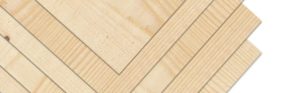
What could be more important to the longevity of a painting than the proper selection and preparation of the substrate you are working on? Having a vested interest in the success of artists using our products, we want to highlight some of the concerns coming from the field of conservation regarding surface checking and the use of plywood as a fine-art cloth. We will offering some possible explanations for this phenomenon and some suggestions to help mitigate the effect of surface checking. Offset, even so, we will outset with some background on how plywood is manufactured to provide a little context.
Plywood and The Generation of Surface Checking
When referring to plywood, we mean engineered wood products constructed past cross-laminating and adhering veneer or thin slices of wood together under heat with pressure using stiff adhesives. The main advantage of this structure, at least for painting supports, is its dimensional stability and resistance to movement when exposed to changes in moisture and humidity. The cantankerous-laminated structure imposes a 'forced stability', in a sense, and while this results in desirable structural attributes, it is also the cause of many of the concerns surrounding plywood.
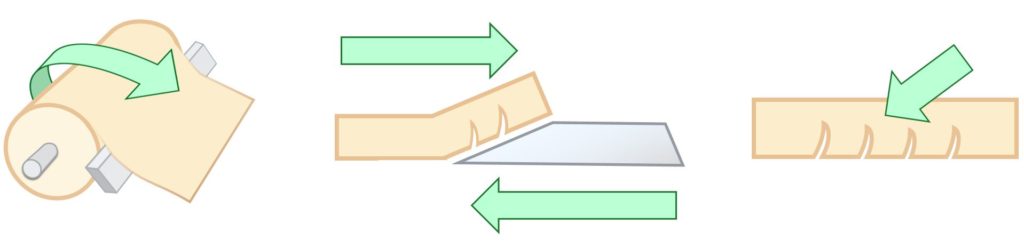
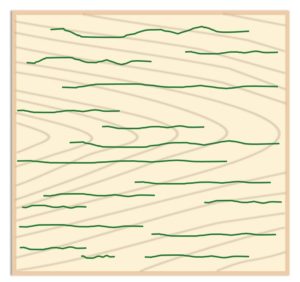
Most plywood veneer is created through rotary lathe cutting, a process where a log is softened by either boiling or steaming and then is fixed and balanced on a lathe where sparse slices of veneer are peeled off in a spiral by a fixed skimming pocketknife as the log rotates. As the pocketknife enters the wood and separates the veneer from the log, information technology is bent tangentially under tremendous shearing forces. The stresses resulting from this can exceed the strength of the wood, causing failure in the form of lathe checks. The term 'checks', when talking most wood, refers to cracks or splits in the wood's surface. Whatsoever stresses from this procedure are then retained in the plywood equally the veneer is laid flat, bonded together and restrained with an adhesive.
The adhesives themselves offering increased resistance to moisture resulting in improved dimensional stability, but wood is withal hygroscopic (or 'h2o loving') and wants to exchange wet with its environment. (Modest, Thou. 1993) As these fluctuations occur, or are introduced as a byproduct of h2o-based paints or grounds, it causes swelling and shrinking in the restrained wood. This fluctuation can create enough tension to overcome the resistance of the plywood to splitting, known as its tensile strength. Equally the natural tendency for wood is to find the easiest method to save this stress, these lathe checks, existence a weakness in the veneer, may open upwards and crusade larger surface checks running along the grain of the wood. If the extent of the checking overcomes the flexibility of the ground layers, they may become visible equally pocket-size cracks and telegraph through subsequent layers of paint.
The Bad
Unfortunately, there is not much that can be done to patch up checking in one case it occurs. There is a take chances that any attempt to fill these cracks could add additional stress to the wood. (Pocket-size, G. 1993) Additional layers of paint intended to cover the groovy would also be susceptible to future great and in that location is no show in our enquiry that finishes will accept an bear upon on the formation of surface checking bated from perhaps slowing it downwardly. (Leavingood, S., Funck, J. W., Reeb, J. Due east., 2022) Attempts to farther restrain the plywood with the improver of cradling could retain even more stress in the woods thereby exacerbating risks. As checking is tied to an intrinsic process in the manufacturing of all plywood, even high grades of plywood could exhibit surface checking.
What are Your Options?
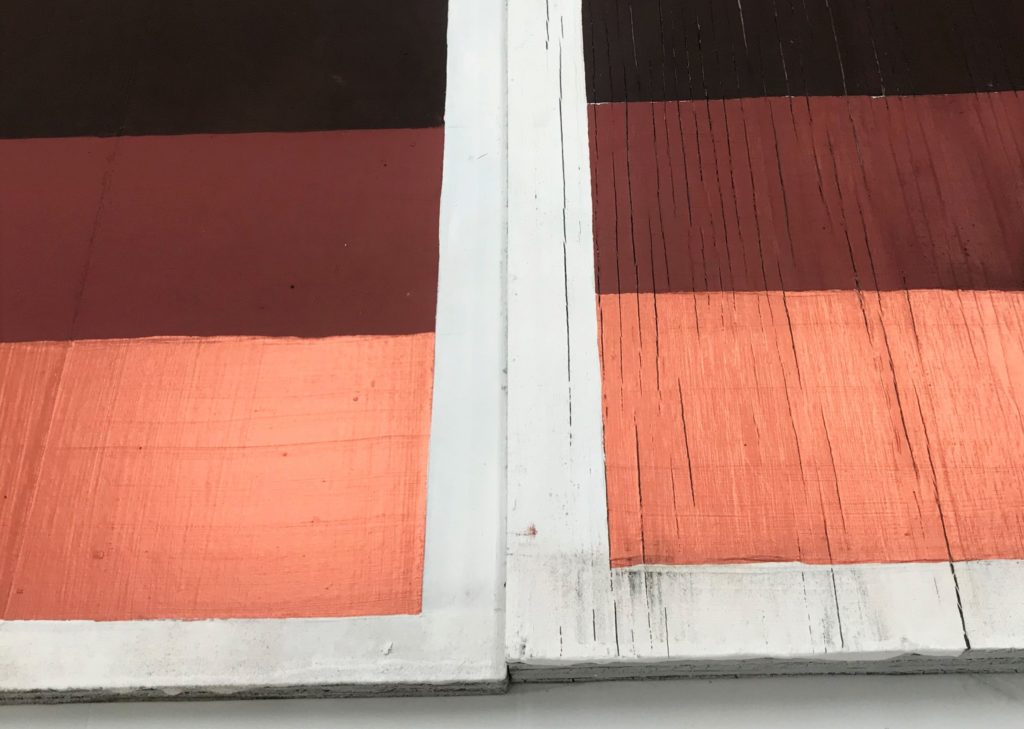
While plywood is far from perfect, information technology is a staple for many artists and will go along to be long afterwards this or other manufactures are published. There are some measures that can exist taken to mitigate the result of surface checking that have some back up in the field of conservation. Ane would be to adhere canvas or newspaper to a console facing. This can help reduce evidence of grain and the effect of checking on pigment layers past providing an intermediary betwixt the painting and the substrate. We oft recommend using Medium Density Overlay (MDO), which is an exterior plywood with a resin impregnated fiber overlay that functions similarly. There is some research suggesting that the agglutinative used in the plywood may also play an integral role in the development of surface checking with water resistant Urea Formaldehyde (UF) adhesives existence more susceptible. (Tremblay, C. Bouffard, J. F. 2022) The phenolic resin that is used to saturate the overlay in MDO and bond the veneer is a water proof adhesive that offers improve wet resistance, which may assistance reduce the affect of the environment or water-based paints and grounds on raising a console's wet content. In that location can also exist measures made to stabilize or control the relative humidity of studio weather, thereby reducing fluctuations that could lead to checking. Even choosing higher grades of plywood with less voids, and of less porous wood species can create less opportunities for lathe checks to travel through to the surface of the veneer. If having a rigid support is what is well-nigh of import, there are many engineered wood alternatives, metal supports and various acrylic sheeting options that could be used as well. Here is some additional information on MDO and a brusque video showing a procedure for adhering paper to panel:
Medium Density Overlay
Adhering Paper to Panel
Over time, every bit our research advances and we develop a greater dialogue with artists and conservators, nosotros will frequently need to reevaluate past recommendations in light of new prove. This is 1 such case and, equally we learn and update our advice, nosotros want to share that knowledge in the hopes that information technology may serve to inform artists of potential risks to the longevity of their works. If you have any questions or comments about this article or any other paint related topic, please feel complimentary to contact our Materials Application Department at aid@goldenpaints.com or by calling 800-959-6543.
References:
- Higher of Forestry, Oregon State University. (2018) Maple Veneer Checking Research. Retrieved from: http://owic.oregonstate.edu/maple-veneer Accessed on March 11, 2022.
- Forbes, C. (1997) Understanding and Minimizing Veneer Checking on Furniture Panels. NC State Extension Publications. Accessed on March eleven, 2022.
- Klim, Susan (1990). Blended Wood Materials in Twentieth Century Piece of furniture. The Conservation Information Network. Retrieved at http://www.wag-aic.org/1990/WAG_90_klim.pdf
- Leavingood, S., Funck , J. W., Reeb, J. E. (2011) A Note on Face Veneer Checking in Maple Plywood, International Forest Products Journal. two:@, 120123.http://dx.doi.org/10.1179/2042645311Y.0000000010
- Minor, M. (1993) The Nature and Origin of Surface Veneer Checking in Plywood. Department of Objects Conservation, The Metropolitan Museum of Art, New York, N.Y.
- Tremblay, C. Bouffard, J. F. (2012) Report on the Effect of Veneer Cracking in the Kitchen Chiffonier and Furniture Manufacture. Natural Resource Canada, Forestry Canada and Economical Development Canada. Value to Wood Report FPI-11-01. Projection No. 201005269.

How To Repair Plywood Face-checking,
Source: https://justpaint.org/surface-checking-and-plywood-is-it-a-concern/
Posted by: stewartlighly.blogspot.com
0 Response to "How To Repair Plywood Face-checking"
Post a Comment